Info, Guides, and How-tos.
  • Home
  • 100% Free CBT Tests
  • YouTube
  • General
  • World
  • Admission
    • NABTEB
    • JAMB
    • IJMB
  • University
    • Private
    • Federal
  • Telecom
    • MTN
    • Glo
  • Military
    • Army, Navy, Police & Air
    • Customs, EFCC, NDLEA, & others
  • Financial
    • Audit & Fintech
    • Banks
  • Home
  • About
  • Contact Us
  • Privacy policy
Info, Guides, and How-tos.
SUBSCRIBE
  • Home
  • 100% Free CBT Tests
  • YouTube
  • General
  • World
  • Admission
    • NABTEB
    • JAMB
    • IJMB
  • University
    • Private
    • Federal
  • Telecom
    • MTN
    • Glo
  • Military
    • Army, Navy, Police & Air
    • Customs, EFCC, NDLEA, & others
  • Financial
    • Audit & Fintech
    • Banks
Info, Guides, and How-tos.
  • Admission
Copyright 2024 - All Right Reserved
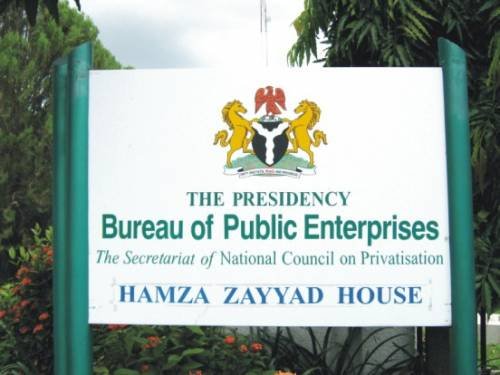
BPE HQ
Govt. Agencies

[VERIFIED] BPE salary structure in Nigeria (Bureau of Public Enterprises)

by Abbey 12th October 2021
written by Abbey

About BPE

The Bureau of Public Enterprise is a Federal Government Agency established under the Privatization and Commercialization Act of 1999. The agency was established to serve as a watchdog for Public-Private dealings.

Privatizations and liberation of critical government institutions especially those related to the infrastructure sector are among the many functions of the Bureau of Public Procurement.

The BPE has more than 43 team members apart from its over 200 private consultants. Since its inception, the Bureau of Public procurement has successfully carried out 284 successful projects.

The Bureau of Public Procurement is the implementation arm of the National Council on Privatization. However, the NCP is solely saddled with the privatization and commercialization of critical government assets.

While the Bureau of Public Procurement is the implementation arm of the National Council on Privatization, its statutory duties are beyond just selling and commercing of government assets. The BPE engages in sector reforms to make public enterprises more effective.

BPE Salary

The Bureau of Public Procurement operates a scale the same as the other ministries, departments, and parastatals which is the consolidated salary scale for all MDAs under the Federal Civil Service Commission. The reviewed salary structure for the Bureau of Public Procurement is summarized below.

  • Grade level 8 (Step 1-7) –   N71,000 to N97,000
  • Grade level 9 (Step 1-8) –   N77,000 to N114,000
  • Grade level 10 (Step 1-6) –   N83,000 to N123,000
  • Grade level 12 (Step 1-8) –   N88,000 to N127,000
  • Grade level 13 (Step 1-8) –   N114,000 to N138,000
  • Grade level 14 (Step 1-6) –   N125,000 to N175,000
  • Grade level 15 (Step 1-6) –   N213,000 to N237,000
  • Grade level 16 (Step 1-5) –   N268,000 to N275,000
  • Grade level 17 (Step 1-5) –   N491,000 to N592,000

BPE Allowances and other Benefits

Apart from their basic salaries, staffs of the Bureau of Public Procurement enjoy several incentives such as;

Health Insurance: Each staff of the agency is covered by the National Health Insurance Scheme.

Travel allowance: Staffs of the Bureau of Procurement travel most of the times for monitoring and evaluation, and each trip comes with a handsome allowance for Air tickets and accommodation in choice hotels.

Housing Allowance: The National Housing Scheme was launched to provide affordable housing to public servants, each staff member of BPE is entitled to a housing unit upon subscription into the housing scheme.

Annual leave: Just as other ministries and agencies, staffs of the Bureau of Public Procurement have an option to go for a paid annual leave for 21 days.

BPE Departments

The Bureau of Public Procurement has various departments and units which help in running the day-to-day activities of the agency. The departments are:

  • FINANCE AND GENERAL SERVICES DEPARTMENT
  • Energy Department
  • DEVELOPMENT INSTITUTIONS AND NATURAL RESOURCES DEPARTMENT
  • INFRASTRUCTURE AND PUBLIC PRIVATE PARTNERSHIP (I&PPP) DEPARTMENT
  • POST TRANSACTION MANAGEMENT DEPARTMENT
  • INDUSTRIES AND COMMUNICATIONS DEPARTMENT
  • Human Resource & General Administration

BPE Management

The management team represents the highest decision-making body of the agency. The management is responsible for making decisions that affect day to day activities of the agency. Apart from that, the management team also work together to ensure that government policies are properly implemented. The management team for the Bureau of Public Procurement include:

1. ALEX OKOH

DIRECTOR-GENERAL

2. YUNANA JACKDELL MALO

DIRECTOR, ENERGY DEPARTMENT

3. IGNATIUS O. AYEWOH

DIRECTOR, FINANCE AND GENERAL SERVICES DEPARTMENT

4. MALLAM AUDU UBA MOHAMMED

DIRECTOR OF DEVELOPMENT INSTITUTIONS AND NATURAL RESOURCES DEPARTMENT

5. AMAECHI CHRISTIAN ALOKE

DIRECTOR, INFRASTRUCTURE AND PUBLIC-PRIVATE PARTNERSHIP (I&PPP) DEPARTMENT

6. Toibudeen Oduniyi

DIRECTOR, POST TRANSACTION MANAGEMENT DEPARTMENT

7. LARAI AHMED BODE

Human Resource & General Administration

No related posts.

12th October 2021 0 comments
0 FacebookTwitterPinterestLinkedinWhatsappTelegramEmail
NITDA
Govt. Agencies

[VERIFIED] NITDA salary structure in Nigeria

by Abbey 12th October 2021
written by Abbey

About NITDA

The National Information and Technology Development Agency is a federal government agency under the Federal Ministry of Communication and Digital Economy.

The agency was established in April 2001 to serve as the legal regulator of the IT sector in Nigeria. The agency engages in licensing OEMs, installation of IT infrastructure, and approval of IT contracts in Nigeria. The National Information and Technology Development Agency is also engaged in licensing of IT softwares to ascertain the security of new digital technologies and to ensure that new softwares not unnecessarily impede on its user’s privacy. The Director-General of the agency is currently KASHIFU INUWA ABDULLAHI, CCIE. He was appointed by President Muhammadu Buhari in 2017.

The National Information and Technology Development Agency has branches and offices in Port Harcourt, Gombe, Lagos, and Kano.

Services Offered by NITDA

Apart from its statutory function as the regulatory powerhouse for the IT sector in Nigeria. The National Information and Technology Development Agency offers a wide range of services to individual businesses and IT providers. The services offered by NITDA include:

  • Data Protection
  • Licensing of OEMs
  • IT Clearance
  • IT Service Provider
  • Registration
  • Domain Registration
  • Software Testing

Departments in NITDA

  • HRA Department
  • ITIS Department
  • CS Department
  • SGF Department
  • FMC Department
  • CPS Department
  • EGDR Department
  • DED Department

NITDA salary structure

Although NITDA is a federal government agency, workers in this agency receive higher pay when compared to other agencies and parastatals since it is a revenue-generating agency. The Federal Ministry of Communications operates a harmonized salary scaling system for all its staff members.

According, to the Salaries, Income, and Wages Commission, the harmonized salary for the National Information and Technology Development Agency is as follow;

  • Grade Level 7 (Step 1-9) – N64,000 to N89,000
  • Grade level 8 (Step 1-9) –   N79,000 to N97,000
  • Grade level 9 (Step 1-6) –   N82,000 to N131,000
  • Grade level 10 (Step 1-6) –   N87,000 to N139,000
  • Grade level 12 (Step 1-6) –   N98,000 to N147,000
  • Grade level 13 (Step 1-6) –   N114,000 to N158,000
  • Grade level 14 (Step 1-5) –   N135,000 to N195,000
  • Grade level 15 (Step 1-5) –   N153,000 to N277,000
  • Grade level 16 (Step 1-5) –   N238,000 to N356,000
  • Grade level 17 (Step 1-5) –   N497,000 to N613,000

Note: Grade 17 Step 5 will automatically become the Director General, subject to the approval of the president.

NITDA Allowance

Housing allowance: Staff members of the National Information and Technology Development Fund are also covered by the housing scheme of the Federal Government of Nigeria under the National Housing Fund.

Data allowance: Most of the work in this agency is done online, therefore staff members of the agency are offered free data by the agency or network providers.

Annual leave allowance: Each staff is entitled to a three-week annual with 10% of his or her annual salary as a leave allowance.

Health care: Staffs of NITDA are also covered by the National Health Insurance. A sick staff member of NITDA or a family member of a NITDA can approach any NHIS approved medical facility to get a free medical session.


NITDA management staff

1. Kashifu Inuwa Abdullahi, CCIE

Director-General/CEO

2. Abdullahi Gambo Usman, PhD

Director -IT Infrastructure Solutions

3. Vincent O. Olatunji, PhD

Director- eGovernment Development and Regulatory

4. Agu Collins Agu, PhD

Director – Corporate Planning and Strategy

5. Mr. Umar E. Ibrahim

Director – Finance, Management and Control

6. Idris Mohammed Yelwa, PhD

Director – Human Resource and Administration

7. Prof. Suleiman Mohammed

Director –Zonal Offices

8. Dimie Shively Warowei, PhD

Director – Freedom of Information Unit

9. Mr Ajayi Babajide Ayodimeji

Head – SERVICOM

10. Mr. Oladejo Olawumi

Ag. Director – Standards Guidelines and Framework

11. Engr. Salisu Kaka

Ag. Director – Digital Economy Development

12. Mrs Hadiza Umar

Head – Corporate Affairs and External Relations

13. Mr. Olatunji Olalekan Kaseem

Head – Internal Audit

14. Bar. Emmanuel Edet

Head – Legal Services and Board Matters

15. Lawan A. Mohammed, PhD

Ag. Director – CyberSecurity

16. Mrs. Fati Zanna Bukar

Head – Procurement Unit

17. Muhammed Saidu Kumo, PhD

Head – Project Management

18. Abubakar A. Dahiru, PhD

Head – Special Duties

19. Mr. Gambo Muhammad Ismail

Head – Budget Development and Monitoring

20. Mr. Yau Isa Garba

Director – National Center for Artificial Intelligence and Robotics

21. Mr. Kasim Sodangi

Ag. National Coordinator – Office for Nigerian Digital Innovation ( ONDI)


No related posts.

12th October 2021 0 comments
0 FacebookTwitterPinterestLinkedinWhatsappTelegramEmail
Agis HQ Abuja
Govt. Agencies

[CONFIRMED] AGIS Abuja salary structure

by Abbey 12th October 2021
written by Abbey

The Abuja Geographic Information Systems (AGIS) is a land registry agency that was established to provide geo-referenced spatial data of the Federal Capital Territory.

The Abuja Geographic Information System was established under the Federal Capital Territory Administration in 2005, AGIS to serve as the official GIS Data source for the Federal Capital Abuja. AGIS possesses an authority backed by the law in all matters related to digital land administration matters in the FCT.

The AGIS “deploys the latest technological and communication hardware with Land Administration System (LAS) and Geographic Information System (GIS) linked to the AGIS Digital land Data Repository with full coverage of aerial photography of Abuja and environs”.

In 2019, AGIS captured a High resolution of 12cm orthophotos of all urban areas in Abuja, and 30 cm orthophotos for all rural areas in the Municipal councils outside the city center which are used to confirm survey coordinates, land use, and development status of the areas in the nation’s capital.

The AGIS has the technical capacity and infrastructure, with its trained and qualified staff to process and produce digitally secured certificates of occupancy and registration of Land documents quickly and effectively to all applicants of land titles in Abuja.

AGIS Management

Some key management staff members of the Abuja Geographic Information System include:

Muhammad Hazat Sule

Director of Information & Customer Service (AGIS/Lands)

G. Bawa

Director, Legal Services AGIS/Lands

AGIS Salary Structure

The Abuja Geographic Information System which is under the Federal Capital Territory Administration uses the Consolidated Public Service Salary Structure (CONPSS). [Check out Federal Capital Development Authority salary here] . [Check out Federal Capital Development Authority salary here] . Check out Abuja Environmental Protection Board Salary.  . The salary for various grades and levels of the agency are summarized below.

  • Grade Level 7 (Step 1-15) – N45,000 to N56,000
  • Grade level 8 (Step 1-15) –   N63,000 to N97,000
  • Grade level 9 (Step 1-15) –   N77,000 to N114,000
  • Grade level 10 (Step 1-15) –   N83,000 to N123,000
  • Grade level 12 (Step 1-11) –   N88,000 to N127,000
  • Grade level 13 (Step 1-11) –   N114,000 to N138,000
  • Grade level 14 (Step 1-9) –   N125,000 to N175,000
  • Grade level 15 (Step 1-9) –   N163,000 to N217,000
  • Grade level 16 (Step 1-9) –   N228,000 to N275,000
  • Grade level 17 (Step 1-9) –   N392,000 to N597,000

AGIS Allowances and other Benefits

Apart from their basic salaries, staff members of the Abuja Geographic Information System enjoy several incentives such as;

Health Insurance: Each staff of the agency is covered by the National Health Insurance Scheme.

Travel allowance: Staffs of the Bureau of Procurement travel most of the time for monitoring and evaluation, and each trip comes with a handsome allowance for Air tickets and accommodation in choice hotels.

Housing Allowance: The National Housing Scheme was launched to provide affordable housing to public servants, each staff member of BPE is entitled to a housing unit upon subscription into the housing scheme.

Annual leave: Just as other departments under FCTA, staff members of AGIS have an option to go for a paid annual leave for 21 days.


No related posts.

12th October 2021 0 comments
0 FacebookTwitterPinterestLinkedinWhatsappTelegramEmail
geoinformatics
Higher Edu

[CONFIRMED] Geoinformatics salary in Nigeria.

by Abbey 13th October 2021
written by Abbey

Surveying and Geoinformatics is an academic discipline that entails the acquisition, analysis, storage, distribution, management, and application of spatial data that are geographically referenced.

The Surveyor is a professional spatial scientist and a geoscientist who is well equipped by the virtue of his professional training in a licensed institution to provide spatial and other environmental information that are required for designing, planning, and implementation of engineering works as well as in the location and usage of resources.

A good geoscientist must have an excellent background in computer science, mathematics, and physics, which gives him strong confidence to tackle a wide range of problems.

A good geoscientist is a product of rigorous and comprehensive academic and practical training in Geomatics which interconnects allied fields such as Geodesy, Hydrography, Land Surveying, Photogrammetry, Remote Sensing, Cartography, and Geoinformatics.

Admission Requirements to Study Geoinformatics in Nigeria

The following are the requirements you must fulfill in other to study Geoinformatics in Nigeria:

(i). UTME Admission

To be eligible for admission, candidates must have completed the Senior Secondary School or its equivalent, obtained five credits in English Language, Mathematics, Physics, and any two other subjects from the following list: Chemistry, Geography, Technical Drawing, Further Mathematics, and Elementary Surveying.

(ii). Direct Entry

A candidate who satisfies the requirements above and who has obtained G.C.E. Advanced level, H.S.C./ IJMB or equivalent passes in Mathematics and Physics or any of the following subjects: Geography, Technical Drawing, Further Mathematics, Building Construction, and Chemistry, may be admitted into 200-level of the programme. Candidates who hold a Higher National Diploma can also be admitted as 300 level students into the programme.

Geography, Technical Drawing, Further Mathematics, Building Construction, and Chemistry.

Note: Universities in Nigeria offer the course as Surveying and Geo-informatics at undergraduate level.

Length of Programme

The programme length is five years for UTME candidates, four years for those admitted with a National Diploma. i.e. Direct Entry

Popular universities where Geoinformatics is offered in Nigeria

Geoinformatics is a very expensive course to operate, this explains why only a few universities offer the course despite the increase in demand for geoscientists especially in the construction sector. The following are the schools where Geoinformatics is offered in Nigeria.

  1. Federal University Of Technology Minna
  2. Federal University Of Technology, Akure
  3. Gregory University, Uturu, Abia State
  4. Imo State University, Owerri
  5. Abubakar Tafawa Balewa University, Bauchi
  6. Bells University Of Technology, Ota
  7. Federal University Of Technology, Owerri
  8. Federal University, Ndufu-Alike, Ebonyi State
  9. Enugu State University Of Science And Technology, Enugu
  10. Modibo Adama University Of Technology, Yola
  11. Nnamdi Azikiwe University, Awka
  12. Obafemi Awolowo University, Ile-Ife
  13. University Of Lagos
  14. University Of Nigeria Nsukka
  15. University Of Benin, Benin City
  16. University Of Ilorin, Ilorin

Geoinformatics salary per month

Geoscientists work in a wide range of projects either individually or as a firm. According to Payscale, the average monthly salary for a Geoinformatics professional is ranges from 60,000 Naira to 450,000 Naira, excluding annual paid leaves, allowances, and tax deductions.

The Geoinformatics field is experience-oriented. Therefore, years of experience and project portfolio greatly influence paycheck size. An analysis of few Surveyors working with reputable firms shows that variables such as educational level, years of experience, and past projects determines salary size.

The median monthly salary for professionals in the Geoinformatics field is 255,000 Naira. Those who work in the oil sector earn more than their counterparts in the construction and public sector. 

Apart from salaries, surveyors are also rewarded with plots of land by their clients as an appreciation. Some surveyors also work as consultants and contractors and are paid per job. The professional charges for surveying a plot of land that is 30m by 30m is 120,000 Naira according to the Nigerian Institution of Surveying . 

Popular fields where Geoinformatics can be applied

There are several fields of life where Knowledge of Geoinformatics can be applied to solve real life issues. The areas where knowledge of geoinformatics can be applied include:

  • Oil and Gas sector
  • Construction Industries
  • Aviation Sector
  • Environmental agencies
  • Land registries
  • Urban planning agencies
  • Remote sensing
  • Federal Surveying offices
  • State Surveying Offices etc.

Required Skillsets for Geoinformatics

For you to become successful in the field of Geoinformatics, some skills are required to be possessed either during your study period or during your professional career.

Basic Knowledge of Python and other languages: Programming is ultimately the most important skill you can learn as a professional in the Geoinformatics field. You need to have basic knowledge of programming languages such as Python, R, and C++. Python and C can be used in running software packages on apps such as AutoCAD and ArcGIS.

Ability to analyze and think well: Geoinformatics professionals must possess the ability to independently analyze issues and arrive at sensible solutions. A good professional must make sure that his decision is logically sound.  

Project Management: As a professional, most times you will find yourself leading a team of experts who may occasionally challenge your authority, in this situation, you must defy the odds and make sure that the team is led to achieving the desired goal and also make sure that the project is managed well by the other team leaders under your management.

Sales Skills: You must be able to sell your services in a way that is professionally accepted. Professionals must possess sales skills in other to convince the buyer about proposed projects. They should have good convincing power and be able to defend their proposals before review panels.

Communication Skills: Geoinformatics professionals must have excellent communication skills because it is one of the basic requirements that will guarantee professional success. He must be able to communicate effectively not only with his colleagues in the organization but also with the clients and business partners. The ability to communicate proposals in a simple language that is understandable by non-professionals is also crucial.

No related posts.

13th October 2021 0 comments
0 FacebookTwitterPinterestLinkedinWhatsappTelegramEmail
local government in Nigeria
Govt. Agencies

[VERIFIED] Local Government Workers salary in Nigeria

by Abbey 23rd October 2021
written by Abbey

About Local Governments in Nigeria

Nigeria has a total of 774 local government areas that constitute the federation. Each local government is controlled by the local government council consisting of the Chairman, Councilors, and other officials.

Among the three tiers of government which are the Federal, State, and Local Government, the local government is the most neglected. Although the constitution of Nigeria recognizes the local government as an independent tier of the 3-tier federal system in Nigeria, politics has not allowed this to become a reality.

The local government serves many functions to communities within its jurisdiction. These duties and functions range from Taxation, Control of markets, Construction of rural roads, registration of births and deaths, control of outdoor advertising, among others

Local Government Staffs and Salaries

When it comes to matters of salaries and pensions in Local Governments, the local government service commission is charged by law to control all issues of wages and salaries in the Local government. Local governments in Nigeria operate a harmonized salary structure with the State Civil Service.

 Therefore, the steps and grades for the state civil service are similar to that of the local government, the only difference is the name.

A level 01 officer in a state civil service will earn the same salary per month as a level 01 officer in the local government. The only difference is that the highest position that can be attained in the local government is a Director, while in the state civil service, the highest is a Permanent Secretary.

Local Government Service Commission Average Salary Scale

Below is the harmonized salary scheme for Local government workers: 

Grade Level 1 is the lowest grade in the local government, and civil servants at this grade are expected to be paid a salary between N22,100 and N23,096 monthly. This makes up to an average annual salary of N250,200 NGN to N305,152

Grade Level 2: Workers are expected to earn between N26,176 per month and N29,610 per month, or N297,968 NGN and N371,760 NGN annually.

Grade Level 3: Civil servants are expected to be paid a monthly salary between N32,085 and N33,878. This amounts to N768,864 NGN to N1,154,496 NGN, annually.

Grade Level 4: Workers in level 4 are paid 37,089 monthly and about 560,949k Naira Yearly.

Grade Level 5: Civil servants in this level receive about 39,032k Naira monthly and about 653,084k yearly.

Grade Level 6: 42,057 Naira monthly and 432,098 Naira annually. This is often the entry position for those with an NCE result.

Grade Level 7: The take-home is N66,386 and N93,781, per month. Their annual salary will then be N916,632 to N1,325,372.

Grade Level 8: This is the entry-level for BSc holders in both the Federal, State Civil Service, and local government. The monthly income for Grade Level 8 employees is between N164,434 and N244,644 NGN. Yearly, the workers will earn between N1,973,208 and N2,935,928. When people join the Local Government Service Commission with a Master’s degree qualification, they are often placed at Grade Level 9, and from there, their rank can increase as high as possible.

Grade Level 9: Worker’s salary is between N193,819 and N289,324. They are paid a sum of N2,435,828 and N3,459,888 per annum.

Grade Level 10: NGN 218,180 and N343,220 monthly. Their annual salary should sum up to be between N2,838,160 and N3,918,400 annually.

Grade Level 12: N263,240 and N379,597 monthly, and an annual take-home of about N3,088,830 and N4,255,064.

Grade Level 14: Civil servants in this level earn between N325,518 and N457,952. The annual salary is about N3,932,256 and N5,463,474.

Grade Level 15: Workers in this level belong to the Managerial Cadre. They earn as much as N360,537 and N502,217 monthly, and an annual salary of about N4,316,564 to N6,326,604.

Grade Level 16: This is the second-highest rank in the local government, a worker in this level is paid a monthly salary between N399,701 and N579,043.

Grade Level 17: This is the highest rank that can be attained in the local governments. Chairmen, Directors, and other managerial cadres are paid with this scale.

Note that Salary varies by state


Poor salary payments in Nigerian Local Governments

Although local governments in Nigeria are said to be independent, Local Government Chairmen sometimes  bow to pressure from the governors who are only interested in controlling local government allocations using appointments and political nominations as a bait.

Most local government workers in Nigeria have become victims of executive recklessness and have had to resort to farming, and sometimes shady deals to survive. This problem is manifesting in the attitudes of local government employees to their jobs. Most of them hardly go to work, and even when they go, they are not found at their duty posts.

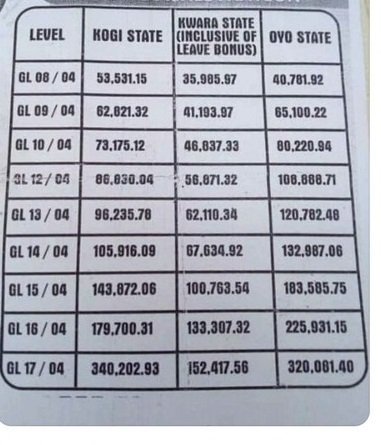
Kwara state has been criticized as one of the worst states to be a local government worker. A comparison of the average monthly salaries for Oyo, Kogi, and Kwara shows that Kwara state has a significantly lower salary. Other states with low salaries include Zamfara, Plateau, and Benue.

kwara state lga

ALLEGED SALARY OF LEVEL 17 OFFICER IN KWARA (2019)

No related posts.

23rd October 2021 0 comments
0 FacebookTwitterPinterestLinkedinWhatsappTelegramEmail
Nigeria-Labour-Congress-1024x769
Govt. Agencies

[CONFIRMED] State Civil Salary Structure in Nigeria

by Abbey 23rd October 2021
written by Abbey

Nigeria is often regarded as the giant of Africa due to its population, size, and abundance of human capital among others. With 36 states, the Federal Republic of Nigeria operates a Presidential system of government as obtainable in other countries such as the United States.

Therefore, since Nigeria operates a federal system, each state has its laws which are enacted through the state house of assembly of each state. Issues such as salaries, taxation, real estate are vested on the states, sometimes in collaboration with the Federal Government.

In most states, in Nigeria, the Civil Service is divided into about 17-grade levels. They range from Grade Level 1 which is the lowest to Grade Level 17 which is the highest.

Most of the jobs at Grade level 01 to at least 06 are minor jobs. The entry-level for those with a Diploma or NCE is normally Grade level 07. Those with a University degree or master’s degree start at grade level 08 and 09 respectively.

The State Civil Service Commission which is headed by a Head of Service appointed by the state governor is the official regulator of the state civil service.

State Civil Service Structure

The 36 states of the federal operate a similar salary structure as the Federal Civil Service Commission. Below is the harmonized salary structure for most states in Nigeria.

Grade Level 1 is the lowest grade in the State Civil Service, and civil servants at this grade are expected to be paid a salary between N22,100 and N23,096 monthly. This makes up to an average annual salary of N250,200 NGN to N305,152

Grade Level 2: Workers are expected to earn between N26,176 per month and N29,610 per month, or N297,968 NGN and N371,760 NGN annually.

Grade Level 3: Civil servants are expected to be paid a monthly salary between N32,085 and N33,878. This amounts to N768,864 NGN to N1,154,496 NGN, annually.

Grade Level 4: Workers in level 4 are paid 37,089 monthly and about 560,949k Naira Yearly.

Grade Level 5: Civil servants in this level receive about 39,032k Naira monthly and about 653,084k yearly.

Grade Level 6: 42,057 Naira monthly and 432,098 Naira annually. This is often the entry position for those with an NCE result.

Grade Level 7: The take home is N66,386 and N93,781, per month. Their annual salary will then be N916,632 to N1,325,372.

Grade Level 8:  This level is the entry-level for those with a first degree i.e. BSc, BTech, B.A, etc., in both the Federal and State Civil Service. The monthly income for Grade Level 8 employees is between N164,434 and N244,644 NGN. Yearly, the workers will earn between N1,973,208 and N2,935,928.

Grade Level 9: Workers salary is between N193,819 and N289,324. They are paid a sum of N2,435,828 and N3,459,888 per annum. This is the entry salary for those who join with a Masters Degree.

Grade Level 10: NGN 218,180 and N343,220 monthly. Their annual salary should sum up to be between N2,838,160 and N3,918,400 annually.

Grade Level 12: N263,240 and N379,597 monthly, and an annual take home of about N3,088,830 and N4,255,064.

Grade Level 13: Workers in this level receive a salary between N294,307 and N417,322 monthly, and the annual income of workers at this level is between N3,501,684 and N5,127,864.

Grade Level 14: Civil servants in this level earn between N325,518 and N457,952. The annual salary is about N3,932,256 and N5,463,474.

Grade Level 15: Workers in this level belong to the Managerial Cadre. They earn as much as N360,537 and N502,217 monthly, and an annual salary of about N4,316,564 to N6,326,604.

Grade Level 16: This the highest rank in the state civil service a worker in this level is paid a monthly salary between N399,701 and N579,043.

I hope this information has helped you in your search for the salary structure of state governments in Nigeria. 

No related posts.

23rd October 2021 0 comments
0 FacebookTwitterPinterestLinkedinWhatsappTelegramEmail
itf logo
Govt. Agencies

[VERIFIED] ITF Salary Structure in Nigeria

by Abbey 23rd October 2021
written by Abbey

The Nigerian Industrial Training Fund also called the ITF was established in 1971 under Decree 47 of 1971, which was amended in 2011. The Industrial Training Fund was established to provide training and develop a generation of skilled manpower in Nigeria.

Since its inception, the fund has contributed massively to the development of skills acquisitions, and training programs across Nigeria. The Student’s Work Experience Scheme is the most popular initiative of the funds which brings academia closer to the industry.

ITF Departments

  • Directorate
  • Admin and Human Resource
  • Finance and Account
  • Information and Communication Technology
  • Business and Training Development
  • Field Services
  • Revenue Inspectorate and Compliance
  • Technical Vocational Skills and Training
  • Procurement
  • Research and Curriculum Development
  • Technical Vocational Skills and Training
  • Corporate Planning
  • Internal Audit
  • Public Affairs
  • Legal and Council Affairs
  • Standardization, Certification, and Consultancy

ITF salary structure

According, to the Salaries, Income, and Wages Commission, the harmonized salary for the Industrial Training fund under the Revenue Generating Agencies salary structure is as follows;

Grade Level 7 (Step 1-5) – N63986 to N87,000

Grade level 8 (Step 1-5) –   N79,089 to N97,000

Grade level 9 (Step 1-5) –   N82,000 to N131,000

Grade level 10 (Step 1-5) –   N87,000 to N139,070

Grade level 12 (Step 1-5) –   N98,070 to N147,009

Grade level 13 (Step 1-4) –   N114,670 to N158,670

Grade level 14 (Step 1-4) –   N135,100 to N195,809

Grade level 15 (Step 1-5) –   N153,004 to N277,100

Grade level 16 (Step 1-6) –   N238,100 to N366,060

Grade level 17 (Step 1-5) –   N597,030 to N665,000

Note: Grade 17 Step 5 will automatically become the Director General, subject to the approval of the president. Also, the Industrial Training fund uses the Consolidated Public Service Salary Structure (Check out the civil service commission salary) (CONPSSS).

ITF Allowances

Housing allowance: Staff members of the Industrial Training Fund are also covered by the housing scheme of the Federal Government of Nigeria under the National Housing Fund which is deducted monthly from their salaries.

Annual leave allowance: Each staff is entitled to a three-week annual with 10% of his or her annual salary as a leave allowance.

Health care: Each employee of the federal government is covered by the national insurance scheme.

Some Important ITF questions

How can I get ITF certificate?

You can get your ITF certificate by submitting the following documents to the Industrial Training Fund.

  • A copy of your company’s certificate of incorporation
  • A copy of your company’s audited account
  • Tax clearance
  • A copy of your company’s payroll

Is ITF compulsory in Nigeria?

The Industrial Training Fund is a compulsory tax that all companies registered or operating in Nigeria must pay.

Who is the DG of ITF in Nigeria?

Presently, the director-general of the Industrial Training Fund is Sir Joseph N. Ari. Joseph Ari was born in 1960 and holds a postgraduate diploma in Journalism.

What is the importance of Siwes?

SIWES which is also known as the Students Industrial Work Experience Scheme is a program funded by the Industrial training fund to bridge the gap between classroom knowledge and industrial practice. The scheme was introduced to provide students with the necessary skills and training that will help them become self-reliant and employable.

No related posts.

23rd October 2021 0 comments
0 FacebookTwitterPinterestLinkedinWhatsappTelegramEmail
paramilitary in Nigeria
Govt. AgenciesMilitary

[VERIFIED] CONPASS Salary Structure in Nigeria

by Abbey 23rd October 2021
written by Abbey

The Nigeria Civil Service (Check out the civil service commission salary) is the largest single public employer of labor in Africa, with a total workforce of about 15million and about 700 Ministries, Departments, and Agencies (MDAs).

The National Income and Wages Commission was set up in 1993 under the Office of the President after series of recommendations by panels set up to checkmate issues with salaries and wages in Nigeria. NSIWC is therefore charged by law to deal with all matters relating to income, wages, and salaries in Nigeria.

The Consolidated Paramilitary Salary Structure is the official salary structure for workers in the paramilitary agencies in Nigeria.

CONPASS SALARY STRUCTURE

The Consolidated Paramilitary Salary Structure (CONPASS), is the official salary scale for paramilitary bodies and institutions in Nigeria. The CONPASS salary structure is similar to that of the Police which is the Consolidated Police Salary Structure (CONPOSS). The lowest-paid worker under the CONPASS salary structure which is 01 Step 1 earns a monthly salary of about 25320 Naira monthly, and 303,669 annually. Below is the approved CONPASS salary scale.

GRADE LEVEL/STEPS MONTHLY SALARY (N) ANNUAL SALARY(N)
CONPASS 01 (Step 1 – 10) 46320 – 47565 410667 – 451057
CONPASS 02 (Step 1 – 10) 47654 – 45067 307567 – 451076
CONPASS 03 (Step 1 – 10) 48854 – 49553 322067 – 492748
CONPASS 04 (Step 1 – 10) 51645 – 55353 323856 – 508364
CONPASS 05 (Step 1 – 10) 54746 – 59756 324545 – 510380
CONPASS 06 (Step 1 – 10) 90456 – 98336 327048 – 521067
CONPASS 7 (Step 1 – 10) 110743 – 130293 382508 – 536278
CONPASS 08 (Step 1 – 10) 143023 – 151087 802745 – 851038
CONPASS 09 (Step 1 – 10) 151739 – 179050 902568 – 987523
CONPASS 10 (Step 1 – 10) 205673 – 223450 2456300 – 2109389
CONPASS 11 (Step 1 – 08) 220384 – 256749 2564739 – 2653738
CONPASS 12 (Step 1 – 08) 236578 – 268906 3122689 – 3245698
CONPASS 13 (Step 1 – 08) 307826 – 320897 3389087 – 4217890
CONPASS 14 (Step 1 – 7) 353238 – 378008 4307649 – 6098647
CONPASS 15 (Step 1 – 6) 425906 – 501657 4807688 – 6856550
     
CONPASS 16 (Step 1 – 6) 425906 – 501657 4807688 – 6856550


SOURCE: NATIONAL INCOME, WAGES, AND SALARIES COMMISSION

Paramilitary agencies in Nigeria

Although paramilitary agencies are not part of the mainstream armed forces (Army, Navy, Airforce) they function similarly. The paramilitary agencies work to ensure the maintenance of law and order within the country. In most cases, they can carry firearms, arrest and prosecute criminals. Below are the recognized paramilitary agencies in Nigeria.

  • The Nigerian Immigration Service
  • The Nigerian Custom Service
  • Federal Fire Service
  • National Drug Law Enforcement Agency
  • Nigeria Security and Civil Defense Corps
  • Nigerian Correctional Service

Fundamentals Terms About Salaries and Wages in Nigeria

Nominal wage: This is the actual amount of money that a worker is paid for a job done within a stipulated period. The nominal wage is paid without considering factors such as inflation.

Real Wage: This is the wage paid to a worker after adjusting the nominal wage to inflation.

Appropriate wage: This is the amount of money that should be paid to a worker to mitigate the effects of inflation and guarantee the value and stability of wages.

Related Questions

What is CONPASS?

CONPASS is the official salary scale for the paramilitaries in Nigeria. CONPASS stands for Consolidated Paramilitary Salary Structure.

What is the salary of level 4 in Nigeria?

A level 4 worker under the Consolidated Paramilitary Salary Structure (CONPASS) earns about 58,000 Naira per month and 696,000 Naira annually.

What is the Salary for level 8 in Nigeria?

A level 08 worker under the Consolidated Paramilitary Salary Structure earns about 125,000 Naira per month.

No related posts.

23rd October 2021 0 comments
0 FacebookTwitterPinterestLinkedinWhatsappTelegramEmail
Integrated-Personnel-and-Payroll-Information-system logo
Govt. Agencies

[EXPLAINED] IPPIS Salary Structure in Nigeria

by Abbey 24th October 2021
written by Abbey

Introduction

The Integrated Personnel Payroll System is a public payroll system developed by the World Bank and adopted by the federal government in 2007 to improve the transparency and accountability in the management of personnel payroll.

The Integrated Personnel Payroll System operates under the office of the Accountant General of the Federation and is charged with the payment of salaries, removal of deductibles, and management of government’s payroll.

The IPPIS has about 600 MDAs that have enrolled as of June 2020. The IPPIS department is charged with the processing of salaries of federal government workers in all MDAs that have been captured.

The IPPIS has also been engaged In controversies recently especially with the Academic Staff Union of Universities who have blamed the platform for shortchanging them and removing deductibles that they did not subscribe to.

IPPIS salary structure

According, to the Salaries, Income, and Wages Commission, the Integrated Personnel Payroll System uses the Consolidated Public Service Salary scheme (CONPSSS). The harmonized salary for the Integrated Personnel Payroll System is as follow;

Grade level 8 (Step 1-9) –   N79,000 to N97,000

Grade level 9 (Step 1-6) –   N82,000 to N131,000

Grade level 10 (Step 1-6) –   N87,000 to N139,000

Grade level 12 (Step 1-6) –   N98,000 to N147,000

Grade level 13 (Step 1-6) –   N114,000 to N158,000

Grade level 14 (Step 1-5) –   N135,000 to N195,000

Grade level 15 (Step 1-5) –   N256,000 to N291,000

Grade level 16 (Step 1-5) –   N342,000 to N467,000

Grade level 17 (Step 1-3) –   N499,000 to N656,000

IPPIS management

The IPPIS is a department under the Office of the Auditor General of the Federation. IPPIS carries out its duties in collaboration with other government agencies such as the Ministry of Finance, Office of the Head of Civil Service, Auditor General of the Federation, and all MDAs enrolled on its platform.

Presently, the Director-General of the Agency is Dr. Ben Nsikak who is responsible for the day to day operations of the agency under the supervision of the Auditor General of the Federation.

IPPIS Departments

The IPPIS operates optimally with the help of the various departments that work together with the director-general of the agency. The following are the department under the Integrated Personnel Payroll System.

  • Admin and Human Resource
  • Finance and Account
  • Information and Communication Technology
  • Inspectorate and Compliance
  • Technical office
  • Procurement
  • Research office
  • Corporate Planning
  • Internal Audit
  • Public Affairs
  • Legal and Council Affairs
  • Standardization, Certification, and Consultancy

Other important info about ippis

What is IPPIS?

IPPIS is an integrated Personnel Payroll System that was introduced by the World Bank and adopted by the Federal Government of Nigeria in 2007, to improve the efficiency and transparency in the management of Payroll.

How to generate a payslip on IPPIS?

To check the payslip:

  • Login to the IPPIS portal here
  • Select admin or subordinate mode and a list of all the workers in your MDA will appear.
  • Select the payslip date and month
  • Click generate

Who introduced IPPIS to Nigeria?

The IPPIS is a world bank project that was adopted by the Federal Government of Nigeria in 2007. The project was launched by the World Bank as part of its attempt to effect public sector reforms, especially in developing countries.

Who is the DG of IPPIS in Nigeria?

The Current Director of IPPIS is Dr. Nsikak Ben. He is charged with the day-to-day operations of the agency, in collaboration with the Auditor General of the Federation.

How many digits is the IPPIS number?

The IPPIS number is a unique number that is attached to each employee on the IPPIS platform. The number must be at least 8 – 20 characters long and must not be special characters or emojis.

How does IPPIS pay salary?

The IPPIS pays salary after the monthly meetings of the revenue mobilization committee. Although there is no specific start or an end date, typically, salaries are paid between 26 – 28 of each month.

No related posts.

24th October 2021 0 comments
0 FacebookTwitterPinterestLinkedinWhatsappTelegramEmail
Research-institute-in-Nigeria
Govt. Agencies

[DETAILED] CONRAISS Salary Structure in Nigeria

by Abbey 24th October 2021
written by Abbey

The Nigeria Civil Service is the largest single public employer of labor in Africa with more than 700 MDAs and about a 15miilion workforce. The National Income and Wages Commission is the official body charged with all matters that relate to income, wages, and salaries in Nigeria.

About CONRAISS

The Consolidated Research and Allied Institutions Salary Structure (CONRAIS) is the official salary structure for workers in Research and related institutes across the Nation. Research institutions are government agencies established by law to provide the necessary support to the nation in the areas of Medicine, Agriculture, etc.

CONRAIS SALARY STRUCTURE

The CONRAIS is the official salary scale for federal government-owned research and allied institutions in Nigeria. The CONRAIS salary structure is similar to that of tertiary institutions which is the Consolidated Tertiary Institutions Salary Structure (CONTISS). The lowest-paid worker under the CONRAIS salary structure which is 01 Step 1 earns a salary of about 25320 Naira monthly, and 303,669 annually. Below is the approved CONRAIS salary scale.

GRADE LEVEL/STEPS

MONTHLY SALARY (N)

ANNUAL SALARY(N)

CONRAIS 01 (Step 1 – 15)

25320 – 34560

303669 – 420657

CONRAIS 02 (Step 1 – 15)

25650 – 45067

307567 – 451076

CONRAIS 03 (Step 1 – 15)

26854 – 46553

322067 – 492748

CONRAIS 04 (Step 1 – 15)

27645 – 47353

323856 – 508364

CONRAIS 05 (Step 1 – 15)

29746 – 49036

324545 – 510380

CONRAIS 06 (Step 1 – 15)

30456 – 50336

327048 – 521067

CONRAIS 07 (Step 1 – 15)

51076 – 62097

382508 – 536278

CONRAIS 08 (Step 1 – 15)

81056 – 87659

802745 – 851038

CONRAIS 09 (Step 1 – 15)

125,087 – 179050

902568 – 987523

CONRAIS 10 (Step 1 – 15)

205673 – 223450

2456300 – 2109389

CONRAIS 11 (Step 1 – 15)

220384 – 256749

2564739 – 2653738

CONRAIS 12 (Step 1 – 15)

236578 – 268906

3122689 – 3245698

CONRAIS 13 (Step 1 – 15)

307826 – 320897

3389087 – 4217890

CONRAIS 14 (Step 1 – 15)

353238 – 378008

4307649 – 6098647

CONRAIS 15 (Step 1 – 15)

425906 – 501657

4807688 – 6856550


SOURCE: NATIONAL INCOME, WAGES, AND SALARIES COMMISSION

Top Agencies under the CONRAISS Salary Structure

National Institute for Tropical Agriculture and Research, Ibadan

Federal Institute of Industrial Research, Abuja

National Institute for Pharmaceutical Research and Development

Nigerian Building and Road Research, Abuja

Federal Institute of Industrial Research, Oshodi

National Water Resources Institute, Lagos

National Horticultural Research Institute, Ibadan

National Agricultural Extension and Research Liaison Services, Zaria

National Institute of Social and Economic Research, Ibadan

National Institute for Oceanography and Marine Research, Lagos

Agricultural Research Council of Nigeria

Fundamentals Terms About Salaries and Wages in Nigeria

Nominal wage: This is the actual amount of money that a worker is paid for a job done within a stipulated period. The nominal wage is paid without considering factors such as inflation.

Real Wage: This is the wage paid to a worker after adjusting the nominal wage to inflation.

Appropriate wage: This is the amount of money that should be paid to a worker to mitigate the effects of inflation and guarantee the value and stability of wages.

Other important questions answered

What is CONRAISS?

Consolidated Research and Allied Institute Salary Structure is a salary scale for the employees of Federal government-owned research institutes in Nigeria. A consolidated salary scale is a totality of all the salaries and allowances a worker is entitled to.

What is the salary of level 7 in Nigeria?

According to the National Salaries, Income, and Wages Commission (NSIWC) level 07 worker under the Consolidated Research and Allied Institute Salary Structure (CONRAIS) earns about N51,076k – N62,097k per month and N382,508k – N536,278k per month.

What is the Salary for level 11 in Nigeria?

A level 12 worker earns N23,6578 – N26,8906 monthly and N3,122,689m – 3,245,698m annually per National Salaries, Income, and Wages Commission (NSIWC).


No related posts.

24th October 2021 0 comments
0 FacebookTwitterPinterestLinkedinWhatsappTelegramEmail
Newer Posts
Older Posts
  • NABTEB
  • Business
  • Rankings
  • Higher Edu
  • Govt. Agencies
  • University
  • Schools
  • Federal
  • Celebs & Net-Worth
  • Private
  • Sports
  • Military
  • Agriculture
  • Financial
  • Relationship
  • Banks
  • World
  • Uncategorised
  • Audit & Fintech
  • scam
  • Telecom
  • MTN
  • Glo
  • How To
  • Army, Navy, Police & Air
  • Admission
  • Customs, EFCC, NDLEA, & others
  • JAMB
  • General
Info, Guides, and How-tos.
  • Home
  • 100% Free CBT Tests
  • YouTube
  • General
  • World
  • Admission
    • NABTEB
    • JAMB
    • IJMB
  • University
    • Private
    • Federal
  • Telecom
    • MTN
    • Glo
  • Military
    • Army, Navy, Police & Air
    • Customs, EFCC, NDLEA, & others
  • Financial
    • Audit & Fintech
    • Banks
  • Home
  • About
  • Contact Us
  • Privacy policy

@2024 - All Right Reserved.


Back To Top