Info, Guides, and How-tos.
  • Home
  • 100% Free CBT Tests
  • YouTube
  • General
  • World
  • Admission
    • NABTEB
    • JAMB
    • IJMB
  • University
    • Private
    • Federal
  • Telecom
    • MTN
    • Glo
  • Military
    • Army, Navy, Police & Air
    • Customs, EFCC, NDLEA, & others
  • Financial
    • Audit & Fintech
    • Banks
  • Home
  • About
  • Contact Us
  • Privacy policy
Info, Guides, and How-tos.
SUBSCRIBE
  • Home
  • 100% Free CBT Tests
  • YouTube
  • General
  • World
  • Admission
    • NABTEB
    • JAMB
    • IJMB
  • University
    • Private
    • Federal
  • Telecom
    • MTN
    • Glo
  • Military
    • Army, Navy, Police & Air
    • Customs, EFCC, NDLEA, & others
  • Financial
    • Audit & Fintech
    • Banks
Info, Guides, and How-tos.
  • Admission
Copyright 2024 - All Right Reserved
Why do Nigerians eat with their hands?
World

Why do Nigerians eat with their hands? [A thorough explanation]

by Abbey 31st January 2023
written by Abbey

1. Availability or non-availability of cutlery

I recall going out with a spoon in my bag during my first few weeks in China because I couldn’t use chopsticks. And spoons were usually not available in most restaurants, so you either sank or swam.

The idea of cutlery is one of the reasons Nigerians use their hands. Most Nigerian homes honestly don’t bother to buy cutlery other than spoons. Those eating utensils are usually found in upper middle-class homes and above, and they are mostly for decoration because most cultured Nigerians will never eat the vast majority of their food with a medium. It doesn’t matter if that fellow is worth a billion dollars.

In poorer homes, cutlery is often seen as something of little necessity. Our local artisans also manufacture some local cutlery for cheap; they might not be as fancy as the imported ones, but they get the job done.

In general, poor families use only spoons, and there are only a couple of them to go around to everyone in the family. The rich have fancy cutlery, but this is just for situations where they have foreign guests or wish to appear fancy. Most rich people will still eat their food with their hands anyway.

So, the availability or scarcity of cutlery plays no role in Nigerians’ insistence on using their hands.

Cutlery just completely ruins the experience except for certain foods.

2. The type of food

The type of food a person is eating will determine whether they use their hands or not. In fact, for some combinations of foods, Nigerians usually use both their hands and cutlery.

Rice

Rice grains are not easy to pick with the hands, and so most Nigerians eat rice with a spoon at least. You would be considered weird if you ate rice with your hands.

I know some cultures, like the Chinese, eat rice with their hands, and it is very easy for them to pick up the rice with their chopsticks, but the type of rice differs. Chinese rice is usually sticky, which makes it easy to pick up with sticks.

Nigerians, however, prefer long-grain rice that does not stick, hence the use of spoons.

Okra soup

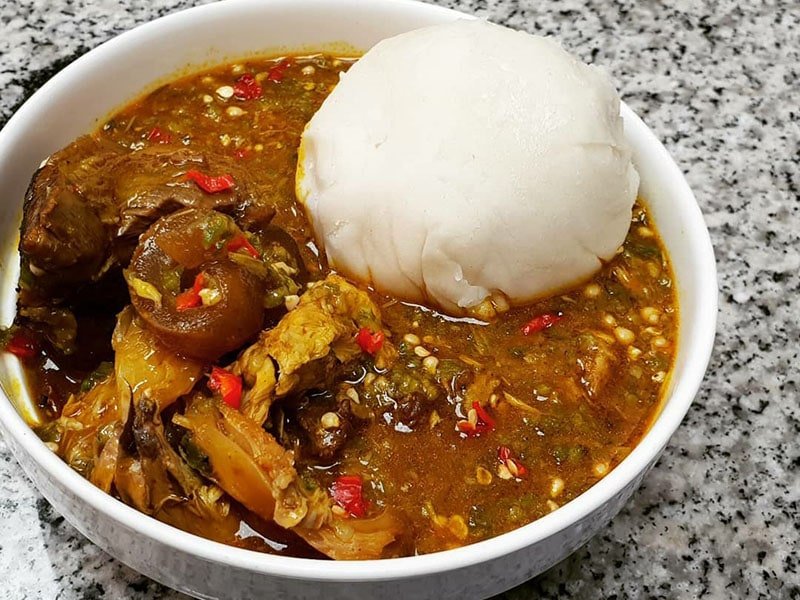
Okro soup is a common delicacy all over the country as it is cheap and easy to make. However, okra is very slimy. So, if you use your spoon or fork to eat okra, it will just keep falling off. This is why Nigerians could only use their hands to eat okro soup, and even with the hands, you still need to be skilled to be able to use your hands.

Efo

Efo is a vegetable soup that is very common in the country. While vegetable soup can be eaten with a spoon or fork quite easily, the only issue is that the soup is hardly ever eaten in isolation as Nigerians often eat it with “solid” food like pounded yam. And this is where it gets tricky. Pinning up some efo soup and some pounded yam at the same time is best done with your hands.

This also applies to most other foods, such as egusi, ofe owerri, ogbono, and so on.

Akara and Pap

Akara and pap are special foods in the way Nigerians eat them. We often use our hands as well as cutlery to eat this food.

Akara is made out of beans and fried in hot oil, which enables it to be more easily picked with the hands. However, it is virtually impossible to use the hands to eat pap.

3. Culture

Culture is the way of life of a group of people, and the idea of using our hands to eat was certainly passed down to us via our ancestors.

It is just the Nigerian thing to eat the majority of our foods with our hands, and this is totally normal behavior. It would be seen as weird if you ate certain foods, like a bowl of amala, with your hands.

So, you cannot say that a certain culture is inferior to yours just because they refuse to do things the same way as you do. It is also part of a white man’s culture to use a spoon, fork, or knife, just as it was passed down to them from generations.

So for purely cultural reasons, we eat with our hands, just like the Chinese eat with their chopsticks.

4. The food just tastes sweeter in your hands.

This could all boil down to the fact that we were all raised to eat with our hands, we got used to it, and therefore we believe it is the best way to do it.

It could also be because when you eat a food like efo and pounded yam, you can more easily spread the soup all around the food, and this is harder to achieve with a spoon.

It could also be because you can eat much faster with your hands than by trying to commandeer the food with a utensil.

It could be that we like the heat of the food on our hands.

It could be…

We are Nigerians, and the best way to eat food is with your hands.
No related posts.

31st January 2023 0 comments
0 FacebookTwitterPinterestLinkedinWhatsappTelegramEmail
Why do Nigerian ladies bleach?
Celebs & Net-Worth

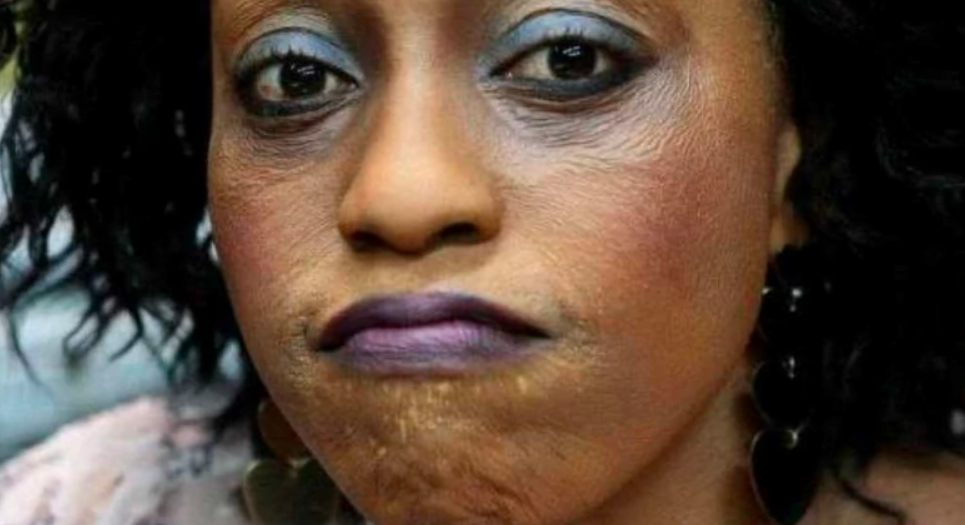
Why do Nigerian ladies bleach? [A honest take]

by Abbey 16th March 2023
written by Abbey

Well, as someone who hates bleaching, there is a chance some readers are not going to like what I have to say. As a Nigerian who has also been with foreign ladies, I believe I qualify to speak about this topic.

Bleaching creams used to be sold by companies and one very popular brand is CAROWHITE. But these days, there are way too many Instagram vendors that sell bleaching creams in all sorts of containers and under other guises.

The most popular guise under which bleaching creams are sold is the so-called “GLOW UP” creams. Please ladies, call a dog by its name.

There is also a massive amount of backlash online if you tell a bleaching woman that she is bleaching. I can only assume that people who bleach tend to defend each other and since there is a massive amount of them these days…well, the bleachers can cancel you online.

I didn’t have to write this blog post this way but I just have a huge disdain for these products. People who use it just tend to smell funny and it just always catches up with you.

Here are a few reasons why Nigerian ladies bleach.

Inferiority complex

This is perhaps a result of colonization where the whites controlled our lands. There is this impression that anything white is good and anything bad is evil.

It is everywhere. It is in our churches and mosques where the major messengers of God are depicted as someone who has fair skin.

Young girls are usually told by their bigger aunties that the only way to attract guys or get their attention is to GLOW up. But this is not entirely wrong. The whole country is obsessed with color. But for people who know the importance of keeping their skin just the way God intended it, people like me, I will always go for the natural. If you happen to be naturally fair, so be it.

Dark skin is a sign of poverty

People have a sick mentality and there is a tendency to see black-skinned people as people who are poor. It is not supposed to be, but the madness sometimes beats my imagination as well.

I get that a lot of people need to work under the sun in their bid to make ends meet. I get it that spending too much time in the sun can make you darker over time. But the issue is that even girls or guys who have never had to work under the sun are still stereotyped and thought of as being poor due to the dark shade of their skin.

It is not uncommon for girls who hit some money to hurriedly bleach their skin. If you ask them why they are now darker, they will claim they now have more money and don’t need to work under the sun, hence the reason why their skin is now glowing.

To attract more males

As a guy, I must admit that girls with lighter skin shades usually draw most of the light to themselves in a gathering. The reason why a lot of our girls are bleaching is because a lot of our guys are patronizing them.

A lot of Nigerian guys also believe that fair girls are usually more beautiful than dark girls. It is absolute nonsense, but that is the reality.

Go on Instagram, girls who are light-skinned often get more likes and follows, than dark-skinned girls. I didn’t make the rules.

Our culture and Parenting

It is not always the case, but fair-skinned girls are usually more favored than the darker-skinned ones in the family.

For example, beating is part of the Nigerian culture. A mother is less likely to beat her child who has fair skin as the marks will be too pronounced as compared to a child who is dark-skinned.

Even in the Yoruba culture, there is always hype about maidens whose skin is fair. If you read most folklore about the mermaids in Africa, they are always described as being fair and their beauty help lure men in.

Here is our bit on this one. We hope we have answered your questions.

No related posts.

16th March 2023 0 comments
0 FacebookTwitterPinterestLinkedinWhatsappTelegramEmail
moors
World

How Ancient African Moors Civilized Europe

by Abbey 31st May 2023
written by Abbey

King Philip III of Spain issued a decree on April 9, 1609, which is considered to be one of the earliest instances of ethnic cleansing. King Philip III of Spain ordered the expulsion of 300,000 Muslim Moriscos during the height of the Spanish Inquisition, which set off one of the cruelest and most tragic periods in Spanish history.

Contrary to popular belief, ancient Africans brought civilization, not the other way around, to Spain and much of Europe.

In 1700 BC, the Greek island of Crete became the center of the first European civilization, which was largely influenced by the black Africans of the Nile Valley. The Romans eventually lost this acquired culture, which led to the start of the Dark Ages, which lasted for five centuries. The Greeks then transmitted this acquired culture to them.

Another group of black Africans, the Moors, put an end to the Dark Ages in Europe and brought civilization back.

The Moors and the Dark Ages

When history is taught in the West, the period called the Middle Ages is generally referred to as the Dark Ages and depicted as the period during which civilization in general, including the acts and sciences, laid somewhat idle. This was certainly true for Europeans but not for Africans. Renowned historian, Czech Anta Job explains how during the Middle Ages, the great empires of the world were black empires and the educational and cultural centers of the world were predominantly African. After the collapse of the Roman Empire multitudes of white warring tribes from the Caucasus were pushed into Western Europe by the invading Huns, the Moors invaded Spanish shores in 711 AD and African Muslims literally civilized the white tribes from Caucasus.

The Moors eventually ruled over Spain, Portugal, North Africa, and southern France for over 700 years. Although generations of Spanish rulers have tried to expunge this era from historical record, recent archaeology and scholarship now sheds new light on how Moorish advances in mathematics, astronomy, art, and philosophy helped propel Europe out of the Dark Ages and into the Renaissance.

The Struggle of the middle ages

One of the most famous British historians, Basil Davidson, noted that during the 8th century, there was no land more admired by its neighbors or more comfortable to live in than a rich African civilization which took shape in Spain. The Moors were unquestionably black and the 16th century English playwriter William Shakespeare used the word Moor as a synonym for African. Education was universal in Muslim Spain while in Christian Europe, 99% of the population was illiterate and even kings could neither read nor write. The Moors boosted a remarkably high literacy rate for a pre-modern society. During an era when Europe had only two universities, the Moors had 17. The founders of Oxford University were inspired to form the institution after visiting universities in Spain. According to the United Nations education body, the oldest university operating in the world today is the University of Alcarrion of Morocco, founded during the height of the Moorish Empire in 859 A.D. by a black woman named Fatima Afiri. In the realm of mathematics, the number zero, the Arabic numerals, and the decimal system were all introduced to Europe by Muslims, assisting them to solve problems far more quickly and accurately and laying the foundation for the scientific revolution. The Moor’s scientific curiosity extended to flight and polymaths.

Ibn Finas made the world’s first scientific attempt to fly in a controlled manner in 875 A.D. Historical archives suggest that his attempt worked but his landing was somewhat less successful. Africans took to the skies some six centuries before the Italian Leonardo da Vinci developed a hang glider. Clearly, the Moors helped to lift the general European populace out of the dark ages and paved the way for the renaissance period. In fact, a large number of the traits on which modern Europe pride itself came to it from Muslim Spain, namely free trade, diplomacy, open borders, etiquette, advanced seafaring, research methods, and key advances in chemistry. At a time when the Moors built 600 public baths and the rulers lived in sumptuous palaces, the monarchs of Germany, France, and England convinced their subjects that cleanliness was a sin and European king dwelled in the big bands with no windows and no chimney, often with only a hole in the roof for the exits of smoke.

In the 10th century, Cordoba was not just the capital of Moorish Spain but also the most important and modern city in Europe. Cordoba boosted a population of half a million and had street lightning, 50 hospitals with running water, 500 mosques, and 17 libraries, one of which held over 500,000 books. All of these achievements occurred at a time when London had a predominantly illiterate population of around 20,000 and had largely forgotten the technical advances of the Romans some 600 years before. Street lamps and paved streets did not appear in London or Paris until hundreds of years later. The Catholic Church forbade money lending which severely hampered any effort at economic progress. Medieval Christian Europe was a miserable lot which was rival with squalor, barbarism, and illiteracy.

The Age of Exploration (Spain and Portugal)

In Europe’s great age of exploration, Spain and Portugal were the leaders in global seafaring. It was the Moorish advances in navigational technology such as the astrolabe and sex nun as well as their improvements in cartography and shipbuilding that paved the way for the age of exploration. Thus, the era of western global dominance of the past half millennium originated from the African Moorish sailors of the Iberian Peninsula during the 1300s. Long before Spanish monarchs commissioned Columbus search for the land to the west, African Muslims amongst others had long since established significant contact with the Americas and left a lasting impression on native culture.

One can only wonder how Columbus could have discovered America when a highly civilized and sophisticated people were watching him arrive from America’s shores. An overwhelming body of new evidence is emerging which proves that Africans had frequently sailed across the Atlantic to the Americas many years before Columbus and indeed before Christ. Dr. Barry Fell of Harvard University alights an array of evidence of Muslims in America before Columbus from scriptures, oral traditions, coin, eyewitness reports, ancient artifacts, Arabic documents, and inscriptions.

The strongest evidence of African presence in America before Columbus comes from the paint of Columbus himself. In 1920, a renowned American historian and linguist Leo Werner of Harvard University in his book Africa and the Discovery of America explained how Columbus noted in his journal that Native Americans had confirmed that black-skinned people had come from the southeast in bull trading in gold-tipped space. Muslim Spain not only collected and perpetuated the intellectual advances of ancient Egypt, Greece, and Roman civilization also expanded on the civilization and made its own vital contributions in fields ranging from astronomy, pharmacology, maritime navigation, architecture, and law.

The centuries-old impression given by some western scholars that the African continent made little or no contributions to civilization and that its people are naturally primitive has unfortunately become the basis of racial prejudice, slavery, colonialism, and the ongoing economic oppression of Africa. If Africans rewrite their true history, they will reveal a glory that they will inevitably seek to recapture.

No related posts.

31st May 2023 0 comments
0 FacebookTwitterPinterestLinkedinWhatsappTelegramEmail
black chinese
World

Proof that Chinese were once black

by Abbey 31st May 2023
written by Abbey

Who were the ancestors of the Chinese?

There has been a great debate on that since Chinese  civilization is as ancient as Greece and Rome, but nobody ever knew where Chinese people came from.  They wanted to know how the Chinese race originated, but no data existed. But now, a study of the Chinese genomes has revealed striking evidence about China’s roots in Black Africa.

But what does that really mean?

Genetic Evidence

It was not easy to find the genetic relationship between people earlier. For example, before DNA  and gene testing, there was no way to find out whether a man was the father of a boy or not.  But after DNA and gene testing, things changed. That’s when genetic engineers and biologists started thinking about knowing the genetic roots of different races on the planet.

That’s how in 1998, the National Academy of Science concluded its study called the Chinese  Human Genome Diversity Project. This was done to find out whose genes the Chinese people carry and the diversity in them. But how does that work? Well, the same way as DNA testing is done.  On a cellular level, DNA shows bands or patterns. Hence, when DNA testing is done,  these patterns are seen to know the similarity in the pattern. The degree of similarity determines how close or far two individuals are on a genetic basis. In 1998, when the National Academy of Science in China revealed the study’s findings, the world was shocked. Nobody had expected that about one-fifth of the Chinese population would have genes similar to Black Africans.

In other words, they had distinctive genes showing the same pattern as that of Black Africans.  It’s clear genetic evidence that most people in China still carry genes that show they have genetic roots in Africa. It should be noted that 20 percent of the Chinese population carry Black genes, which means that almost all Chinese came from Africa as Black people.

Even after hundreds of thousands of years, they still carry genes that show African roots. That’s something striking. With time, due to interbreeding, the genes become submissive and ultimately, they vanish.  However, in this case, it’s different. After thousands of years, Black genes still dominate and make up 20 percent of Chinese people. This simply means that Black genes have more survival chances and superior traits. That’s why they have not been replaced.

Archaeological evidence

Africans, especially the Egyptians, have been obsessed with building gigantic structures like the pyramids of Giza.  Shaping and moving gigantic stone blocks weighing tons was a feat that is impossible to comprehend today. However, Egypt is not the only place where pyramids are found, suggesting that Africans, when they migrated, took this construction style with them. Since archaeologists say that Africa was where humans originated and migrated to other parts of the world, it might be true that the  Chinese emperors and dynasties were the earliest manifestation of Black African roots.

Today, there are about 100 pyramids in the city of Xian. These are the pyramids located at the mausoleum of the first Qin emperor, also known as the Terracotta army. The mausoleum is located approximately 30 kilometers east of the city of Xian in Shanxi province. Something to notice is the mausoleum was constructed in the late third century BCE as the final resting place of Qin Shi Huang, the first emperor of China. We are talking about 5,000 years ago when the pyramids of Giza were being constructed. That’s clear proof that Black Africans were the people who built the pyramids in Xian.

However, some disagree, saying these pyramids are just hills due to erosion.  But there are more striking signs that small Black people built these pyramids during the Mu civilization. The pyramids built around the world were all built by Black people based on the contents of the pyramids. Some people dispute this fact, but researchers are challenged to examine the contents of the pyramids throughout the world to find out who the builders are.

Examining the content, engineering, and techniques of the Giza pyramids and Xian City pyramids is not difficult. However, no archaeologist has ever done so simply to avoid discovering a link between  Chinese and African civilizations. This raises another question. Where are the Chinese emperors  Black? This question will be answered in the next piece of evidence we will tell you about.

China’s first dynasty and emperors were Black

China’s rich history includes the fact that its first dynasty and emperor, King Tu, were of Afrocoid or Black origins. The Shang dynasty, which followed, was the earliest documented rulership in China and is credited with unifying the country’s earliest elements to form its first civilization. Under the Black dynasty, they were given the name Naki, meaning Black man in Chinese.  Calling an emperor a Black man is not a coincidence and does not pass without reason.  It simply suggests that the entire dynasty had Black roots. Fuxi, the legendary first Chinese emperor, was a woolly-haired Black man who is said to have established government, social institutions, and cultural inventions, including the Book of Change, which is one of the oldest and most revered systems of philosophy. Their physical features have been noted, proving they manifested their Black roots, unlike today’s Chinese. Not much time had passed back then and there were clear indications in Chinese emperors of their Black roots. Emperor Hong Wu, a Muslim of Sudanese and Mongolian descent, founded the Great Ming dynasty and left a lasting impact on China.  The skills that set the foundation for Shaolin Kung Fu are believed to have descended from both Indian and Afrikoid origins, and evidence of the deep interrelation between Africa and martial arts in Asia can be seen in the white garment hall of the Shaolin monastery in Hunan province.

Not only that, but archaeological studies have located an infrastructure inhabited by Blacks in early Chinese history, with reports of major kingdoms ruled by Blacks frequent in  Chinese documents. Chinese folklore and classical books speak of diminutive Blacks with Black features. Emperor Xiaowenui and Emperor Shan were spoken of as Black Africans, and there were kingdoms of Blacks in southwest China. The sacred Manchu dynasty shows a great multitude of Black people. Emperor Po Yi of the Manchu Kawa is most distinctly Black. Chinese chronicles report that a Black empire existed in South China at the beginning of the country’s history. All this suggests that China’s roots in Africa are not merely a claim, but a fact backed up by evidence.  However, if you try to research and find archaeological records, you will be surprised to see that none exist for ordinary people.

All records that create a link between Chinese and African civilizations have been either removed or suppressed. Not only that but even after the genetic evidence proving China’s roots in Africa, some archaeologists are biased not to believe in the pyramids found in Xian City. However, they cannot deny it because if they did, they would have to prove that the pyramids are different, which in reality are not.  You will find in no available history books that major contributors and even the establishment of the Chinese dynasties were Black people. They just don’t want that to spread. Black people did not come as conquerors or invaders, imposing their own culture on China. Rather, they were native Chinese having features similar to Black Africans.

No related posts.

31st May 2023 0 comments
0 FacebookTwitterPinterestLinkedinWhatsappTelegramEmail
africa
World

The Origin of the name Africa

by Abbey 31st May 2023
written by Abbey

Africa is the world’s second largest continent, both by size and number, after Asia. Its land mass hold 54 countries and 9 territories. Over 1.11 billion people call Africa home and call themselves African. Africa and being African has become a core part of the identity of millions of the continent’s inhabitants. But where does this world, to which so many have such an emotional connection, come from?

The exact origins of the word Africa are contentious, but there is much about its history that is known. We know that the word Africa was first used by the Romans to describe that part of the Carthaginian Empire which lies in present-day Tunisia. When the Romans conquered Carthage in the 2nd century BCE, giving them jurisdiction over most of North Africa, they divided North Africa into multiple provinces. Among these, there were Africa Pre-Consularis, Northern Tunisia, and Africa Nova, much of present-day Algeria, also called Numidia.

The name Africa and the Romans

All historians agree that it was the Roman use of the term Africa for part of Tunisia and Northern Algeria which ultimately, almost 2,000 years later, gave the continent its name. There is, however, no consensus amongst scholars as to why the Romans decided to call this province Africa. Over the years, a small number of theories have gained traction. One of the most popular subjections for the origins of the name Africa is that it is derived from the Roman’s name for a tribe living in the northern reaches of Tunisia believed to possibly be the Babel people.

The Romans variously named these people Afri, Afra, and Ifa. Some believe that Africa is a contraction of Afrika Terra, meaning the land of the Afri. There is, however, no evidence in the primary sources that the term Africa Terra was used to describe the region, nor is there direct evidence that it is from the name Afri that the Romans derived the term Africa. In the early 16th century, the famous Medevian traveller and scholar, Johannes Leo Africanus, who had travelled across most of North Africa giving detailed account of all what he saw there, suggested that the name Africa was derived from the Greek word Afriki, meaning without code or without oral.

In a similar line of thought, other historians have suggested that the Romans may have derived the name from the Latin word for sun or earth, namely, Africa. Where exactly the Romans got the name Africa from is, however, still in dispute. For most of its history, the Roman word Africa was not used to describe the continent as a whole, but rather only a very small section of North Africa, what today constitutes the northern part of Tunisia.

Were the Greeks responsible for naming Africa?

Prior to the late 16th century, there were a variety of names used to describe the various constituent parts of the north half of Africa, with Libya, Ethiopia, Sudan, and Guinea being by far the most common names used. For the ancient Greeks, almost everything south of the Mediterranean Sea and west of the Nile was referred to as Libya. This was also the name given by the ancient Greeks to the Babylon people who occupied most of that land. The ancient Greeks believed their world was divided into three greater regions, Europa, Asia, and Libya, all centered around the Aegean Sea.

They also believed that the dividing line between Libya and Asia was the Nile River, placing half of Egypt in Asia and the other half in Libya. For many centuries, even into the late medieval period, cartographers followed the Greek example, placing the Nile as the dividing line between the land masses. Early Arabic cartographers tended to follow the Greeks in the usage of their time Libya for vast swathes of North Africa beyond Egypt. Later Arabic cartographers began to call the areas south of the Sahara extending from the Senegal River to the Red Sea, billared as Sudan, the land of the blacks which is where the contemporary nation of Sudan gets its name from. Some European cartographers who tended to privilege Latinate derivations above others preferred the Roman term for the region, using the word Africa to designate the northern land mass rather than the Greek term Libya, although Libya was still used by many. During the Middle Ages, Christian cartographers adopted the Greek division of the word into three greater regions surrounding the Aegean Sea. The medieval cartographers, however, moved this understanding away from the geographical conception of the word into a more metaphorical understanding. They aligned each region to one of the Abraham’s descendants, giving Asia to shame, Europe to jab at and Africa to arm. This tripartite conception of the word was represented in extremely abstract and symbolic rather than geographical form as is shown in the image above.

In the 15th century, after the Portuguese had rounded the Cape and made contact with the Christian Empire of Abyssinia, the Greek term Ethiopia, meaning land of the dark-skinned or burnt, which was used by the Greek cartographers to designate the land below Egypt and the Saharan, was revived again to loosely describe all of the tropical area of the continent below the Sahara. At roughly the same time, the Portuguese began to refer to all of West Africa below the Sahara as Guine, the land inhabited by the Guinnes people. Guinnes was a generic term used for black people in contrast to the more brown people of much of North Africa. The term Guina became ever more popular to describe the region of West Africa accessible from the Gulf of Guinea. Until the mid 17th century, the terms Guine and Ethiopia were popularly used to describe the land south of the Sahara.

Libya was commonly used for the north-west of Africa above the Sahara. Africa was used sometime east of Libya to denote the north-west of Africa and sometimes along the Libya to denote the central and northern region of Africa which today is predominantly occupied by Tunisia. Before the late 16th century, Africa was used only to denote part of the larger landmass that makes up the continent primarily that area occupied by Tunisia and Morocco. For most of its history, the continent of Africa as we know it today had many names for all its various constituents, none of which was used to describe the landmass as a whole.

The European Exploration

It was only in the 16th and 17th centuries with the European Age of Exploration that the concept of continent as contiguous landmasses bordered as separated by oceans began to take shape. As European exploration opened up the idea of the continent, so cartographers began to give single geographical names to an entire continent.

By the end of the 17th century, the name Africa had worn out over the others, beating names such as Jini, Libya or Ethiopia to become the name for the entire continent as we know it today. While Africa worn out over all the other, often more popular names is unclear although some historians have argued that it is due to the 17th and 18th-century preference for Latinate terms above all others. The word Africa has been a marker on the continent for millennia but its dominance over the continent and its place as a name for the people who live on it is only a very recent phenomenon.

No related posts.

31st May 2023 0 comments
0 FacebookTwitterPinterestLinkedinWhatsappTelegramEmail
Is Nigeria richer than Qatar?
World

Is Nigeria richer than Qatar?

by Abbey 19th October 2023
written by Abbey

I’m a Nigerian by citizenship, which means that I’m qualified to talk about Nigeria, but I’ve also at least stayed in Qatar for a tiny bit of time in my life, which also means that I’m qualified to look at both countries and compare them side by side. Qatar is a tiny country. In fact, Qatar’s total area is 11,586 square kilometers, compared to Nigeria’s 923,768 square kilometers. So Nigeria is a huge country, while Qatar makes up about 1.25 percent of the size of Nigeria.

Also doing some statistics, Nigeria has, depending on who we are quoting, approximately 225 million people while Qatar, on the other hand, has barely 3 million people living in that piece of land. By simply looking at photographs of both countries, you can tell that Qatar is a lot more developed and a lot more richer than Nigeria, but perhaps we should not go by my words and look at a few things that separate both countries.

In terms of economic numbers or indices, Nigeria’s annual GDP for 2022 is 477,376 million dollars, as compared to Qatar’s annual GDP for 2022 of 237,296 million dollars. However, Nigeria is a country of population of well over 200 million people, with Qatar having just around 3 million people. The effect of this is that the GDP per capita of Qatar is at a staggering $90,000 minimum as compared to Nigeria’s $2,000 GDP.

Poverty in Nigeria

Nigeria is largely a poor country but if there’s something good about Nigeria, it has to be with the cost of living index. As compared to Qatar, Nigeria is ranked as number 153rd country in the list of the most expensive countries to live in as compared to Qatar where things are more expensive and Qatar is ranked at number 15th on that list. Nigeria is a totally poor country and in the year 2022, there was a large-scale survey between a few organizations in the United Nations as well as the Nigerian Bureau of Statistics and the survey was conducted on 56,000 households across all the 36 states of Nigeria and the results are horrible.

It was concluded that 63% of Nigeria’s which amounts to 133 million people are multidimensionally poor and the majority of the people are in northern Nigeria. 65% of the people are in northern Nigeria and 35% of these poor people are in southern Nigeria and this poverty varies across different states in the federations.

According to the reports that the Nigerian government sanctioned itself, it was discovered that 133 million people are poor. These poor people cook with dung or they use wood or charcoal and they don’t have access to clean energy and the sanitation in these places and health care and food and housings are terrible in these locations and in general multidimensional poverty is really a big deal in Nigeria even a lot of Nigerians are also poor in terms of money.

Monetary poverty is also high in Nigeria. This is definitely not the case in Qatar. Qatar is a well-run society. The citizens are well taken care of. If people are poor in Qatar, it’s most likely the immigrants who come to do the low-paying jobs in Qatar. The citizens themselves are poor because they make very good use of their oil money and the money circulates as compared to Nigeria where only the elites and the politicians keep all the money that belongs to everybody. You can tell me in the comments. Definitely, Nigeria is a much much poorer country than Qatar. Thank you.

No related posts.

19th October 2023 0 comments
0 FacebookTwitterPinterestLinkedinWhatsappTelegramEmail
Who is Nigeria's Queen?
World

Who is Nigeria’s Queen?

by Abbey 19th October 2023
written by Abbey

Nigeria does not operate a monarchy system of government. Nigeria elects a head of state and there’s no monarchy or queen that dictates or controls the government of Nigeria. However this was not always the case. Nigeria gained its independence in 1960 and between 1960 and 1963 Nigeria was actually under the monarchy of the United Kingdom in person of Queen Elizabeth II. Nigeria shared that monarchy with Australia, Canada, and of course, the United Kingdom and some certain sovereign states.

In 1963 Nigeria abolished the idea of having a monarchy in the country and does its own election. In fact, the monarchy was abolished on 1st October 1963. If there’s going to be a Queen of Nigeria, it has to be Queen Elizabeth II, but like I said, this only lasted for three years post Nigeria’s independence.

However there are kings in Nigeria, and even though at the presidential level, Nigeria does not operate a monarchy system; the towns and villages all have kings alongside elected politicians to rule. And these kings also have their own wives and the wives are queens.

This is similar across the geopolitical landscape of Nigeria. We have queens that are wives of kings and they also have some sort of constitutional duty to their community. And the power bestowed on a queen is usually equivalent to how powerful her king is.

So the more powerful a queen is, is an indication that the king is also very powerful. And there are different types of kings in Nigeria. There are some that just rule, some hamlets, some villages, and there are some that rule very huge cities. The first class kings as they are so called.

So Nigeria does not have a queen ruler at least at the federal level but they are queens that rule the smaller hamlets and villages and towns but their power doesn’t really extend as they are basically just an appendage of the king himself.

If you have more questions you can ask in the comments thank you.

No related posts.

19th October 2023 0 comments
0 FacebookTwitterPinterestLinkedinWhatsappTelegramEmail
Is Nigeria in Qatar?
World

Is Nigeria in Qatar?

by Abbey 19th October 2023
written by Abbey

Nigeria and Qatar are two very different countries. Although they have a few things in common, Qatar is one of the most beautiful countries that I have ever seen. It doesn’t have a very large land mass, and the advantage of that is that you can easily get from one part of the country to the other.

In fact, when the last world was held in Qatar, people loved the competition because they were able to attend multiple matches in the same day because the country is small and very interconnected.I also have a tiny personal experience traveling through Qatar. I had a layover for 24 hours. I still remember admiring their museum, it was so hot but the rooms were all air-conditioned.Qatar is a fantastic country, but Qatar and Nigeria are definitely not the same. The Qatari people are of Asian or Arabic origin, and the Nigerians are Africans, West Africa to be precise. They are blacks. Qatar and Nigeria also have a few things in common and this has to do with the production of petrol.

Nigeria is the sixth-highest producer of oil in the world and Qatar also produces a lot of oil. In fact, that is how they made all their money, and they were able to turn their country into the paradise that it is today.

Unfortunately, for Nigeria, our own oil money has not been put to good use. We can’t even maintain a refinery, and we have to depend on other countries to refine our own oil and the fuel is so expensive to buy and the citizens don’t like this.

There is really no basis to compare Nigeria with Qatar. So Nigeria is definitely not Qatar. They are not the same people. But they have oil in common; which is true. And they also have the Muslim religion in common.

Both countries have a lot of Muslim population

Qatar is a very Muslim country. In Nigeria, around half the population is Muslims. And the Nigerian Muslims are more concentrated in northern parts of Nigeria, but Qatar is a wholly Muslim country. And that is all about the similarities that could exist between both countries.

But definitely, they are two different countries. I would like you to leave a comment for me in this section and ask any more questions that you have about Nigeria and Qatar.

Qatar is a country I’ve been to, a very beautiful place. Nigeria is my country, also a beautiful place, by the way. But they are definitely two different countries. different countries, different cultures, different races, different continents.

Nigeria is not in Qatar, Nigeria and Qatar are two covering countries. They do not share the same border. Nigeria is in Africa while Qatar is an asian/middle east country.

No related posts.

19th October 2023 0 comments
0 FacebookTwitterPinterestLinkedinWhatsappTelegramEmail
Did Nigeria qualify for AFCON 2023?
World

Did Nigeria qualify for AFCON 2023?

by Abbey 20th October 2023
written by Abbey

The African Cup of Nations, also known as the CAN 2023, is also known as the TotalEnergies 2023 African Cup of Nations, and it will be the 34th edition of this competition.

This competition normally holds every two years across African countries, and 24 teams from Africa are going to compete in the competition. The location of the 2023 African Cup of Nations will be in Côte d’Ivoire.

The Francophone country is going to host the competition from the 13th of January to the 11th of February 2024. Now I know how it looks like.
The competition is supposed to be held in 2023, but in fact, it will start in January 2024.

Africa has a weird way of doing things, and this is one of them. Nigeria has indeed qualified for the 2023 African Cup of Nations and the draw was held recently in Côte d’Ivoire. Nigeria will play in Group A of the competition alongside the host, Ivory Coast, as well as Equitura Guinea and Guinea-Bissau.

These are the teams that will make up the group Nigeria will play in. There are other groups: group B; group C; group D; group E; and group F. So in total, there will be six groups for the AFCON 2023 and all the group winners will qualify and their runner-ups will also qualify.

Lastly, the highest ranking third place teams will also qualify for the knockout stage of the competition and by February 11th we are going to know who the winner of the competition will be.

Arguably Nigeria actually has the best attacking force with impressive players playing in Italy Germany, France, Spain, and even the English Premier League. Nigeria’s attack will be spearheaded by the incredible Victor Osimhen. There is also the 6ft4, immensely strong attacker of Bayer Leverkusen in the form of Victor Boniface. Taiwo Awoniyi of Nottingham forest is also expected to play a big role in this competition. Nigeria currently has the best set of attackers in Africa.

So Nigeria should be able to win this year’s African Cup of Nations. But we have to wait and see the surprise that the North African countries have in stock because they always do have surprises for us.

If you have any more questions, you can ask me in the comment section. This is all it will be regarding the qualification of Nigeria for the African 23, which will be held in 2024. Nigeria will indeed participate in that competition.

And we wish the Super Eagles the very best of luck. Thank you.

No related posts.

20th October 2023 0 comments
0 FacebookTwitterPinterestLinkedinWhatsappTelegramEmail
Will Nigeria qualify for DV Visa in 2024?
World

Will Nigeria qualify for DV Visa in 2024?

by Abbey 20th October 2023
written by Abbey

The DV visa was introduced to encourage people from diverse ethnic and cultural societies to come to the United States.

The United States prides itself on being a country of immigrants. Immigrants can come to the United States and become whatever they want to be, and they can have the American dream.

And that is why the DV visa was introduced in 1995 in order to encourage people to come to the United States of America. About 55,000 people are eligible for this visa every year.

The implication of this is that if it is deemed that a particular people or country are already in high numbers or are already in diverse numbers in the United States of America, such people or such countries will not be allowed into the United States under the DV visa because they are already a lot of them in the country.

One of such country is definitely Nigeria which has a very high population in the United States of America. So the United States stopped issuing this visa to Nigerians since there are too many of them already.

This visa encourages people to come to the United States, and people in the same household can apply separately. For example, if you are in the household of a husband and wife and you have three kids, they would encourage all of you to apply so that if one person,  in that household gets picked, that person can come to the United States of America with the entire family.

So it is usually a good idea for people even in the same household to apply. However, the only rule is that you cannot apply more than once a year.

Can Nigerians apply for the DV Visa in 2024?

Nigeria is still not qualified to apply in 2024. More than 50,000 Nigerian citizens of that country have come to America in the past five years.

So, that is why Nigerians are usually not eligible to apply. And the list of countries that have more than 50,000 nationals in the United States in the past five years Includes countries such as Brazil, China, Canada, Bangladesh, Colombia, El Salvador, Guatemala, Dominican Republic, Haiti, India, Nigeria, Pakistan, Mexico, Philippines, South Korea, United Kingdom, except for Northern Island and its dependent territories and lastly Vietnam.

So, these countries cannot apply for the DV 2024  visa yet. Even Nigeria is not qualified yet. So, I hope that answers your question. If you have more questions you want to ask me, we can do so in the comments section.

No related posts.

20th October 2023 0 comments
0 FacebookTwitterPinterestLinkedinWhatsappTelegramEmail
Newer Posts
Older Posts
  • NABTEB
  • Business
  • Rankings
  • Higher Edu
  • Govt. Agencies
  • University
  • Schools
  • Federal
  • Celebs & Net-Worth
  • Private
  • Sports
  • Military
  • Agriculture
  • Financial
  • Relationship
  • Banks
  • World
  • Uncategorised
  • Audit & Fintech
  • scam
  • Telecom
  • MTN
  • Glo
  • How To
  • Army, Navy, Police & Air
  • Admission
  • Customs, EFCC, NDLEA, & others
  • JAMB
  • General
Info, Guides, and How-tos.
  • Home
  • 100% Free CBT Tests
  • YouTube
  • General
  • World
  • Admission
    • NABTEB
    • JAMB
    • IJMB
  • University
    • Private
    • Federal
  • Telecom
    • MTN
    • Glo
  • Military
    • Army, Navy, Police & Air
    • Customs, EFCC, NDLEA, & others
  • Financial
    • Audit & Fintech
    • Banks
  • Home
  • About
  • Contact Us
  • Privacy policy

@2024 - All Right Reserved.


Back To Top